
A Wool Lover’s Reading List
Books for those who love, wear and use wool wherever you can - you are a true devotee.
In graduate school, I built a tower of books that became some of my most important references. Some were guidebooks into the world of wool and all of its features. Others were academic tomes and too academic to become part of my regular library. But many held essential technical knowledge about fiber, and others were unexpectedly funny—stories of people on their own journeys to understand where fabric actually comes from.
Not surprisingly, I find myself especially drawn to stories of people trying to build regional and local textile systems at a mid-scale level—it’s a complex and fascinating challenge. Next up is Making It In America: The Almost Impossible Quest to Manufacture in the U.S.A. (And How It Got That Way) by Rachel Slade.
These are the books I return to often. I hope you’ll explore them yourself. And if you have others to add, I’d love to hear them.
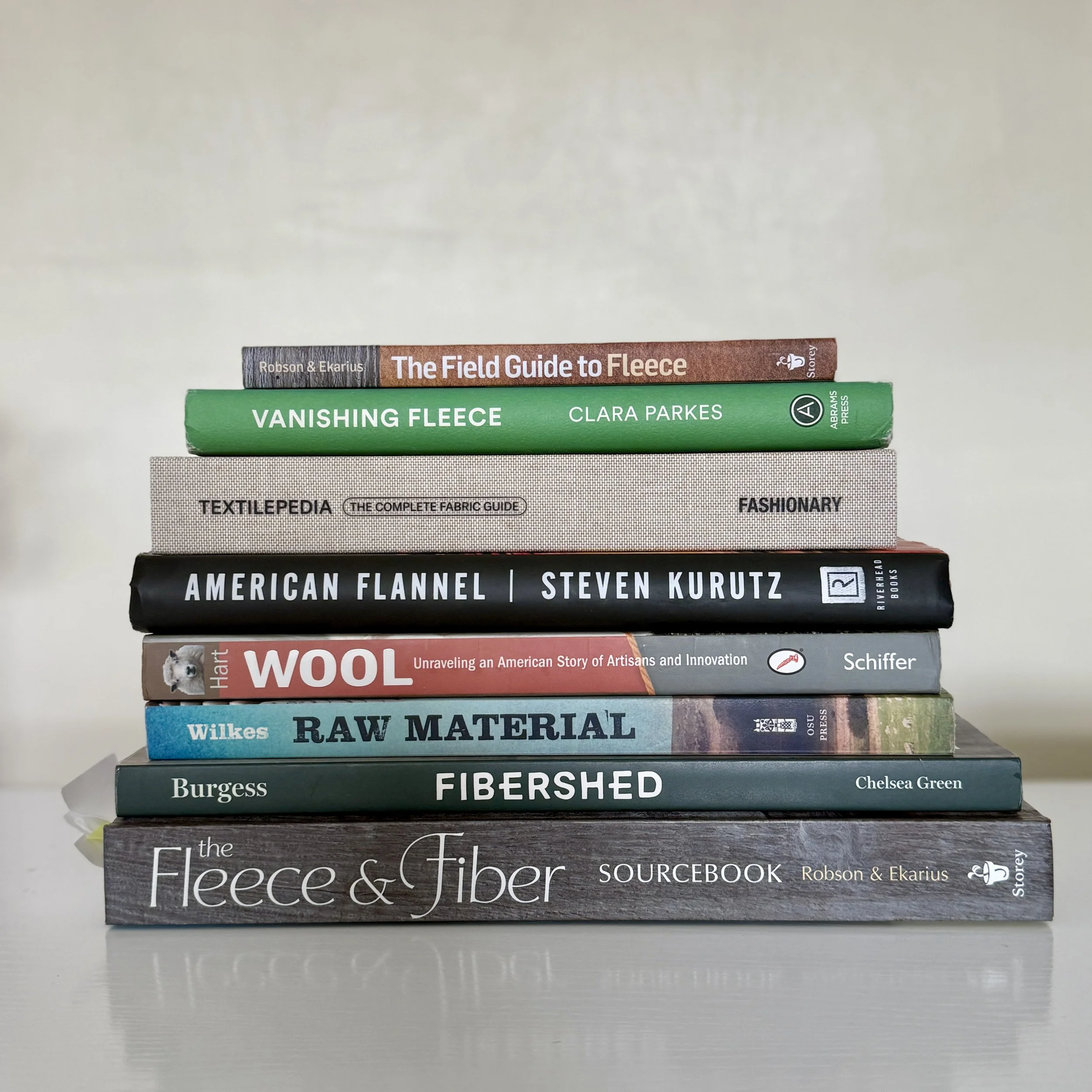
Bellwether Favorites for Wool Lovers
🐑 The Fleece & Fiber Sourcebook by Debra Robson and Carol Ekarius
If there is one foundational text for understanding wool, this is it.
More field guide than coffee table book, it catalogs over 200 fiber-producing animals and walks you through what their fibers actually do—how they behave from fleece to yarn to finished textile.
It teaches you to notice:
crimp and luster
elasticity and strength
how fiber structure shapes outcome
It’s the book that turns wool into a complex and fascinating fiber.
♼ Fibershed by Rebecca Burgess
This book expands the conversation outward—from fiber to place.
Rebecca Burgess explores what it means to build regional textile systems rooted in soil, climate, and community. It’s both practical and visionary, offering a model for how fiber can be grown, processed, and used within a defined geography.
For those of us working with American wool, it reframes what’s possible: not just products, but ecosystems.
🐑 Raw Material: Working Wool in the West by Stephany Wilkes
Part memoir, part investigation, this book follows the journey of making a sweater entirely from locally sourced fibers.
It’s honest about the complexity—financial, logistical, and emotional—of working within domestic fiber systems. And in that honesty, it reveals just how fractured (and full of potential) the American textile landscape is.
It’s a story about trying, failing, learning, and continuing anyway.
🐑 Vanishing Fleece by Clara Parkes
This one feels especially important right now. I loved this one because in so many ways, it mimicked my experience.
Clara Parkes follows a single bale of American wool—from a ranch in Wyoming through scouring, spinning, and knitting—uncovering the fragile, often invisible infrastructure behind it.
What emerges is a clear-eyed look at just how much of the American wool system has disappeared—and what remains.
It’s not nostalgic. It’s specific. And because of that, it makes the stakes tangible: what we lose when we lose the systems that support wool.
🧶 Textilepedia: the Complete Fabric Guide by the Fashionary Team
This is the modern reference.
Clear, visual, and comprehensive, it breaks down fibers, weaves, finishes, and textile structures in a way that’s immediately usable. Where the Fleece & Fiber Sourcebook teaches you about origin, Textilepedia helps you understand construction.
It’s especially useful when moving between knitting, weaving, and design decisions.
🧶 The Curse of the Boyfriend Sweater: Essays on Crafting by Alanna Okun
And then, something lighter—but no less meaningful. A great one for knitters!
This book captures the cultural side of knitting: the humor, superstition, and shared stories that exist alongside the craft. It’s a reminder that textiles are never just material—they carry emotion, relationships, and lived experience.
Even in a deeply material practice, there is always a human story woven through.
A Note from the Studio
These books concentrate on the themes and questions that I find so interesting—trying to understand wool not just as fiber, but as a regional, sustainable material. Taken together, these books make an important impact. I started to notice where things come from and how they are made. I feel emboldened to make different choices.
These books have shaped my perspective. I urge you to go deeper, to understand more, to reconnect the material you use to the place it came from.
Next Up… the Bellwether Weaving Book Shelf. Stay tuned.